„Warum können wir das nicht viel öfter machen?“‘Why can’t we do this much more often?’„Warum können wir das nicht viel öfter machen?“
What makes the inclusive sailing courses for children and young people on the Alster tick – and why we urgently need partners
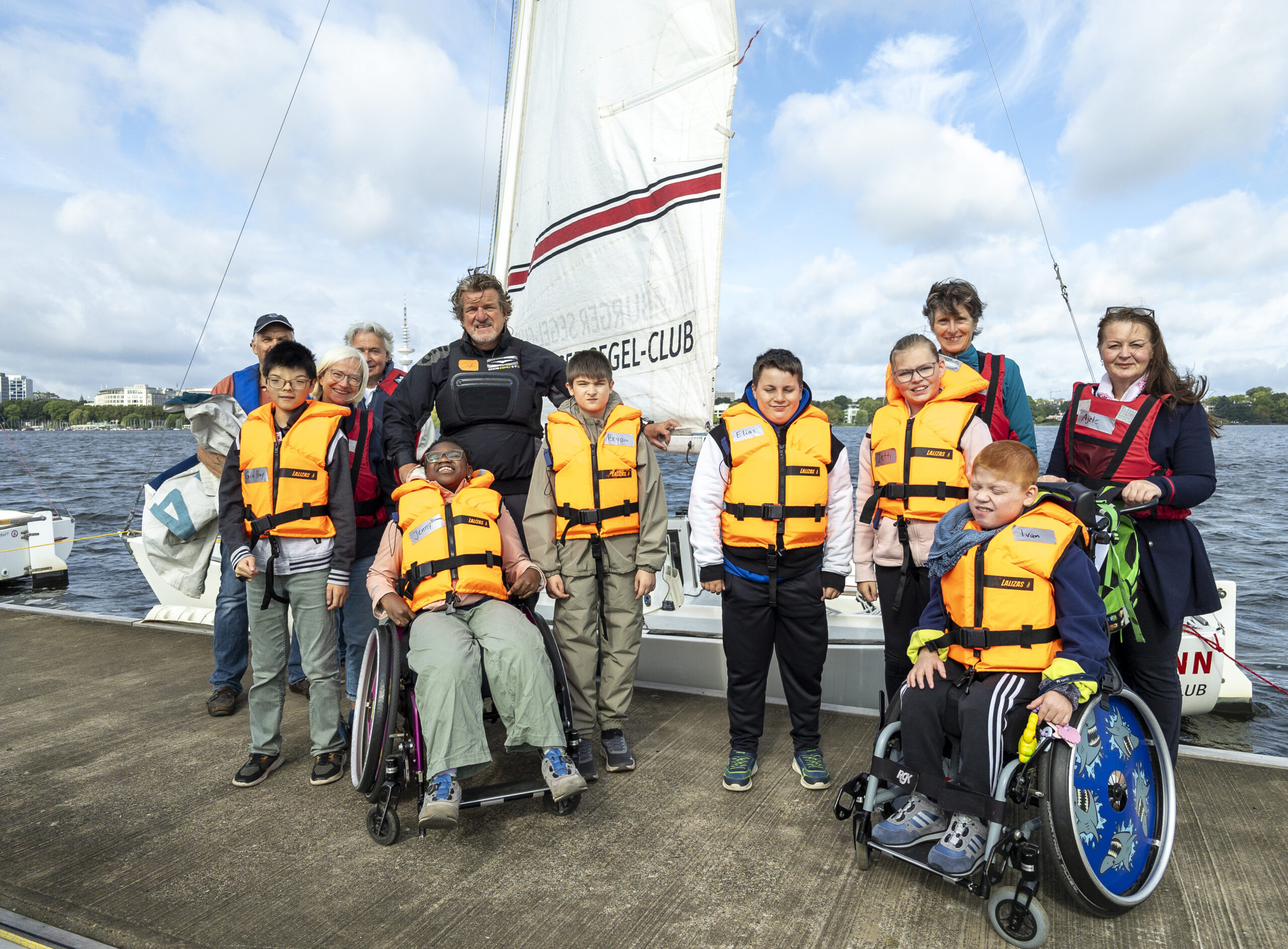
Every week on Hamburg’s Alster, children and young people with and without disabilities sail together – on the same boats, in the same courses. That is inclusive sailing. And it all started with a question.
At the end of the first taster sailing days at the Bugenhagen School in Alsterdorf, the young people kept asking the same question: “Why can’t we do this much more often?”
That question set the whole thing in motion. It’s the reason why individual sailing days have turned into weekly courses. And one course has become nine. We’ve never had to persuade anyone to come back. We’ve just had to make sure they did come back.
Sailing has a profound effect on people
“Sailing seems to have a profound effect on people – it brings people together, builds trust and allows everyone to surpass themselves,” said one of our instructors, summarising a day’s course. Michael Aldag from the Hamburg Sailing Club puts it this way: “It’s incredible to see how sailing changes these children. The fascination of moving forward using only the power of the wind – suddenly, any disabilities become secondary, and pure joy of life takes over.”
Sophia, 10, who is visually impaired, describes it from her perspective: “Every time the wind and water rush past my ears, I feel a little adventure inside me.”
A teacher at the Bugenhagen School in Alsterdorf was so moved by the changes in her pupils that she took the initiative to ask for the course to be held weekly rather than every two weeks. She said: “Inclusive sailing has a real impact on my pupils; it’s like the best form of therapy.”
Just how far this can go is demonstrated by a young man who has been experiencing and supporting our projects at first hand for years. He has ADHD and realised for himself years ago what sailing does for him: during the sailing season, he hardly needs any medication at all. He says: “For me, sailing is the best therapy.” Today, he sails intensively and actively competes in regattas.
For us, however, sailing is first and foremost a sport – wind, skill, competition, fun. The fact that it has such a positive impact on the side is a gift. But nobody comes to us to be treated. Everyone comes to sail.
And we see it for ourselves in the courses. Shy participants come into their own, laugh and develop a visible sense of self-confidence as part of the team on board. An eleven-year-old boy from the Werner Otto Institute, who’d never sailed before, showed a talent that surprised his parents and our coaches alike – ever since, we’ve been working together to find ways to support his development further.
It’s hard to describe what that looks like. You have to see it for yourself:
What inclusive sailing does for people – in one minute: https://www.youtube.com/shorts/jXoErhL678E
What parents experience
The parents tell the story most honestly. Sandra Hein, mother of a young sailor, has written about her first year with us:
“Last May, our daughter sat in a sailing boat for the first time. Today, we’re able to accompany her on her journey at regattas, training sessions and major sailing events. When we look back on this year, one thing fills us above all else: gratitude.”
“As parents of a child with a disability, we understandably often worry a great deal. For me, as a mother, in particular, it isn’t always easy to let go. But especially over the last year, I’ve seen what a positive effect all that time on the water has had on our daughter.
Time and again, I see and feel how she is growing through this, becoming more independent and gaining self-confidence.”
“Here, the focus isn’t on what children can’t do, but on what can be made possible.”
“Our children grow through the challenges they face, gain self-confidence, take on responsibility and make their own decisions. They are taken seriously and are allowed to decide for themselves when they need a break or which challenges they feel confident enough to tackle.”
We’re well aware that parents are hesitant at first. Time and again, we see that the barriers are initially in their minds, and parents believe their child cannot sail. In every course so far, our instructors have managed to convince everyone involved otherwise.
Together – that’s the real point
Even more important than the sailing itself is who you sail with.
At the Bugenhagen School in Alsterdorf, whole classes take to the water. Not a support group, not a select few – the whole class. Children and young people with severe physical disabilities and learning difficulties, wheelchair users, children and young people on the autism spectrum, and their classmates – all together on the same boats, every Wednesday and Thursday morning. A fixed part of the timetable. Not as an outing, not as a project week.
One boy from our courses didn’t want to learn to sail on his own at all. He wanted to start together with his best friend – and so the two of them learnt together and worked towards the Wednesday regatta together, even though only one of them has a disability.
The Werner-Otto Institute sails with us regularly on Thursday afternoons on the Alster: children and young people aged eight and over, some with disabilities, some without, all together on the water. The institute’s director, Dr Joachim Riedel, was on board himself with his daughter – a partner who doesn’t just watch from the jetty, but sails along with us.
After the summer holidays, Lilli and her mum Sylvia turned up at the jetty on the spur of the moment. Lilli has Down’s syndrome and is interested in sailing. We didn’t have to think twice: lifejacket on, off we went onto the water. You could tell just how much she was enjoying it. And most importantly: Lilli wants to come back.
At the Altona-Oevelgönne Sailing Club, children and young people with disabilities take part in regular training sessions on the Optimist, the classic beginner’s dinghy for children – right in the thick of it, not on the sidelines. And in our family sailing sessions, parents and children sail together – for many families, this is the very first sport they’ve ever done together where nobody is being looked after and nobody is doing the looking after; instead, everyone is a beginner at the same time.
That’s exactly what we mean when we say: out on the water, we’re all equal. Disabilities stay on dry land.
From taster days to regattas – for anyone who wants to
Getting started with us is as accessible as possible. A taster day, an afternoon, a single trip – give it a go, with no barriers, no waiting, and no long explanations.
But it doesn’t stop there. A one-off taster session is great, and an activity day creates memories, attracts attention and puts everyone in a good mood. The crucial question arises the day after: what’s next? Those who sail regularly experience a sense of self-efficacy, routine and a sense of belonging – and eventually realise that they’re not just a guest here, but a crew member.
And some want more. Sailing is one of the few sports in which people with and without disabilities compete against each other in the same regatta – on the same course, in the same classification. That’s why our programme doesn’t stop at recreational sailing. Anyone with the ambition will find a path into competitive regatta sailing with us. The first children and young people from our courses are now actively competing in regattas – not in a separate category for children, but in regular races, side by side with adult sailors.
Sophia sat in a sailing boat for the first time in May 2025; her first lesson was given by Susann Beucke, Olympic silver medallist at Tokyo 2021. A year later, she was on the starting line at the Helga Cup, the world’s largest women’s regatta, and brought home a silver medal in her class from the International German Championship in inclusive sailing.
At the inclusive regatta held alongside the SailGP in Sassnitz, Stefanie Drese, Minister for Social Affairs of Mecklenburg-Western Pomerania, summed it up: “From ten-year-old Sophia, who is visually impaired and only started sailing in 2025, to the medallists at the 2026 European Championships – they are all part of the same competition.”
Since October 2025, young sailors with disabilities have been receiving targeted training for competitive regatta sailing as part of the Heinz Kettler Inclusive Youth Sailing Team Germany, a joint initiative supported by the Hamburg Sailing Club, the Heinz Kettler Foundation and us. Clemens Kraus, our founder, describes our aim as follows: “Our goal is not simply for these children and young people to tag along. We want to empower them so that they can take on responsibility independently on the water – as competent members of the team.” The training is explicitly not geared towards a special class, but towards regular regatta sailing.
Wolf Dieter Jahn from the Hamburg Sailing Club once put it this way: “It is a matter close to our hearts to give all children and young people access to sailing. When we see the enthusiasm and joy with which the young people sail, we know that we are on the right track.”
Even with the most severe disabilities
There’s a phrase we often hear: ‘That’s not possible for everyone.’
But it is. It is possible.
On the accessible RS Venture Connect, even those who cannot sit upright unaided can take the helm. The boat can be adapted to suit individual needs. This means that anyone who wants to come on board can do so, regardless of how mobile they are on land. Some wheelchair users remain in their own wheelchairs.
And it involves more than just steering – everything that goes with sailing, from mooring the boat to clearing away at the end. It is precisely these tasks that foster a sense of routine, responsibility and the feeling of being a fully-fledged member of the crew.
It’s just not the same as it is for others. We are regularly approached by families of children and young people with the most severe disabilities, for whom a group course with up to twenty children and young people isn’t suitable. They need one-to-one training, sometimes one-to-two – a coach at their side the whole time.
We started these one-to-one training sessions in 2025 and expanded the programme in 2026. Eight children and young people are now training in this way. It is the most labour-intensive part of our work – and the one that determines whether inclusion remains just a word or becomes part of everyday life.
It is also the part where demand is growing the fastest. We are receiving more enquiries than we can accommodate.
And then the same thing happens there as everywhere else. After the first session, the question comes: ‘When are we going sailing again?’
How it all began
In 2020, the first inclusive sailing world championship took place in Hamburg. Noa, a girl with trisomy 21, sailed there with her father. Gregor Ronig recalls: “It’s absolutely fantastic when people sail against each other here without worrying about who has what – it’s just great fun.”
But the moment that followed was decisive. Noa went back to her class at the Bugenhagen School in Alsterdorf and invited her classmates: “Come along. To the Alster. Together.”
This led to the first joint sailing day in 2023 for around 40 children, young people, teachers and parents. Taster days for further classes followed in 2024. In 2025, this developed into a weekly school sailing course, and since 2026, two year groups have been sailing.
‘Inclusive Alster’ is not a single project, but a network. Seven Hamburg water sports clubs have joined forces so that people with and without disabilities can sail, row and paddle together – in one area, right in the heart of the city. Each club contributes what it has: premises, boats, coaches and experience.
The network comprises the Hamburg Canoe Club, the Hamburg Sailing Club, the Hamburg Sailing Association, the Favorite Hammonia Rowing Club, the Teichwiesen Rowing Club, the Altona-Oevelgönne Sailing Club and Wir sind Wir Inclusion in Sailing e.V.
And it has long been about more than just sailing. At the Ruderverein an den Teichwiesen, blind and visually impaired children and young people have been rowing since April 2026. At the Ruder-Club Favorite Hammonia, the FunFari group trains people with learning difficulties and competes in the Special Olympics National Games. At the Hamburger Kanu-Club, people with and without disabilities paddle together in two-person canoes.
The Hamburg Sailing Association supports the whole initiative as the regional association. Together, we aim to make the Alster the world’s most inclusive water sports area.
We now regularly take over 160 children and young people with a wide range of disabilities out onto the water – with the Bugenhagen School Alsterdorf, the Werner Otto Institute, Campus Uhlenhorst and the Elfenwiese School, in courses for blind and visually impaired children and young people, in one-to-one and one-to-two training, in training sessions for the very youngest children, and as part of the Heinz Kettler Inclusive Youth Sailing Team Germany.
In December 2025, the sailing course project with the Bugenhagen School Alsterdorf was awarded the Annemarie Dose Prize. The prize money has been used in its entirety to expand the courses.
Together with the Norddeutscher Regatta Verein, we are running the sailing course with Campus Uhlenhorst and the inclusive regatta team, the BAT Sailing Team – inclusion in action on the regatta course.
This film shows what the network is achieving as a whole: what is taking place on the Alster: https://www.youtube.com/watch?v=JrpsZ8IYIBo. And if you’d like to know exactly what activities are on offer – from school sailing courses to inclusive rowing and canoeing – you can find them here: Inclusive Alster 2026: https://www.wir-sind-wir.org/inklusive-alster-2026/
One child invited their class. The rest is down to the efforts of many people.
What it all comes down to now
What we’re ever short of isn’t ideas. It’s the fees for our volunteer coaches – and the money for the upkeep and maintenance of the boats.
Boats, infrastructure, theory lessons, coordination and organisation are all covered by the clubs and many volunteers. Alongside boat maintenance, coaches’ fees are the biggest expense – and one that we have to raise funds for anew for every single course. Then there’s the fleet: boats that are in use every week need care, maintenance and regular new sails, and every additional place on the water requires another accessible boat. Without qualified coaches, no boat goes out – and certainly not for one-to-one training. An example illustrates just how much depends on this: without a coach’s personal sponsorship, we would not have had sufficient funds to train one of our young female sailors for a whole year.
Added to this is the question of duration. Of all the courses and programmes we offer, exactly two are currently funded for up to three years. For all the others, funding ends with the course year, and every autumn we have to fight anew for the funds for the coming season.
A course that doesn’t know in the autumn whether it will start again in the spring isn’t a programme – it’s a promise subject to revocation. Children and young people notice this. Schools plan differently. Coaches take on other jobs.
That is why we are so grateful to the Kroschke Children’s Foundation. It has been supporting our courses for years, has already secured the course with Elfenwiese School for 2027, and has committed to further projects with us for the coming years.
Nadine Weber-Kroschke, the foundation’s chair, says of the collaboration: “We can only achieve this together with partners such as Wir sind Wir Inclusion in Sailing or the Werner Otto Institute.” You only realise the value of this reliability once you’ve found yourself in a situation in November where you didn’t know who would be paying for the training in April.
What we’re looking for
We want to further expand our one-to-one and one-to-two training. This isn’t just a side note in our programme. It’s at the very heart of what inclusion in sport means: that, ultimately, even the children and young people who require more support get to sail. That no one is excluded because their support needs are too great.
To achieve this, we need patrons, sponsors, companies and foundations. And we don’t need them for just one year, but for several – because that is what turns an initiative into a reliable service.
Specifically, we are seeking support for:
- Coaches’ fees – a key expense without which no course can take place
- Places on one-to-one and one-to-two training sessions for children and young people with the most severe disabilities
- full school sailing courses spanning an entire season
- additional accessible boats, so that more children and young people can get out on the water at the same time
- the upkeep of the existing fleet – boats that are in use every week require care, maintenance and regular replacement of sails
- long-term partnerships that turn a single year’s course into a long-term prospect
And we’re not just looking for money. Each of our courses is led by a trained, qualified freelance coach – and supported by volunteer coaches. It is this teamwork that makes it possible for everyone on board to actually sail, rather than just tagging along. It is precisely for this support that we are looking for volunteer trainers who are keen to get involved in our projects on a regular basis. Important to note: this mainly involves daytime hours. The school sailing courses take place in the mornings, and many one-to-one sessions in the early afternoon.
If you have solid sailing experience, enjoy working with children and young people, and can imagine being out on the Alster on a regular basis, then you’ve come to the right place. A coaching licence is welcome but not essential – and experience in inclusive sailing is definitely not a requirement; we’ll teach you that.
If you’d like to contribute through your company or organisation, please get in touch. We’d love to show you what we do over a morning on the Alster when the boats are out – you don’t need to be able to sail to do this. You’ll hear the same question there as we do.
Because the phrase we use to describe this project isn’t just a slogan. It’s a promise we have to fulfil anew every year:
All children sail – no child is left on shore.
#AllOnBoard #WeAllSail
Sven Jürgensen, Chair
We are Wir Inclusion in Sailing e.V.
sven.juergensen@wir-sind-wir.org
Sven Jürgensen, Chair
We are Wir Inclusion in Sailing e.V. · sven.juergensen@wir-sind-wir.org